Module 1: Introduction
Forest growth and carbon with uncertainty from tree-rings and census data
Forest growth and carbon with uncertainty from tree-rings and census data
Objectives
In this workshop we will introduce and work with a Bayesian statistical modelling framework to:
use tree-ring data to estimate annual tree diameter growth with uncertainty
integrate tree-ring data with forest census data to estimate annual growth for all trees on the plot (i.e. those with and without tree ring data)
show how this approach can directly link annual growth to climate and other drivers, and
scale annual growth to carbon accumulation.
We will work through examples developed in R and RStudio. Experience with R is helpful but not required. All are welcome.
Motivation
Forest Carbon Cycling
Managing forests to increase carbon uptake and storage is among the proposed carbon drawdown strategies. Tree-ring data makes it possible to quantify annual tree growth and carbon accumulation. While annually resolved, determining forest carbon accumulation from tree-rings requires complete sampling, or a set of assumptions that limit reliability. Tree-ring datasets are also subject to the fading record problem– they do not capture mortality processes.
Forest censuses, which re-measure individual trees over time, (e.g. Nationwide forest inventories (NFIs), ForestGEO plots, etc), provide snapshots of stand-level dynamics (forest growth, mortality, and recruitment processes) and thus forest carbon. This census data often lacks the annual temporal resolution needed to understand patterns and attribute forest carbon accumulation drivers. Participants of this workshop will learn how tree ring data alone, and tree ring data in combination with forest census data can be used to estimate forest carbon.
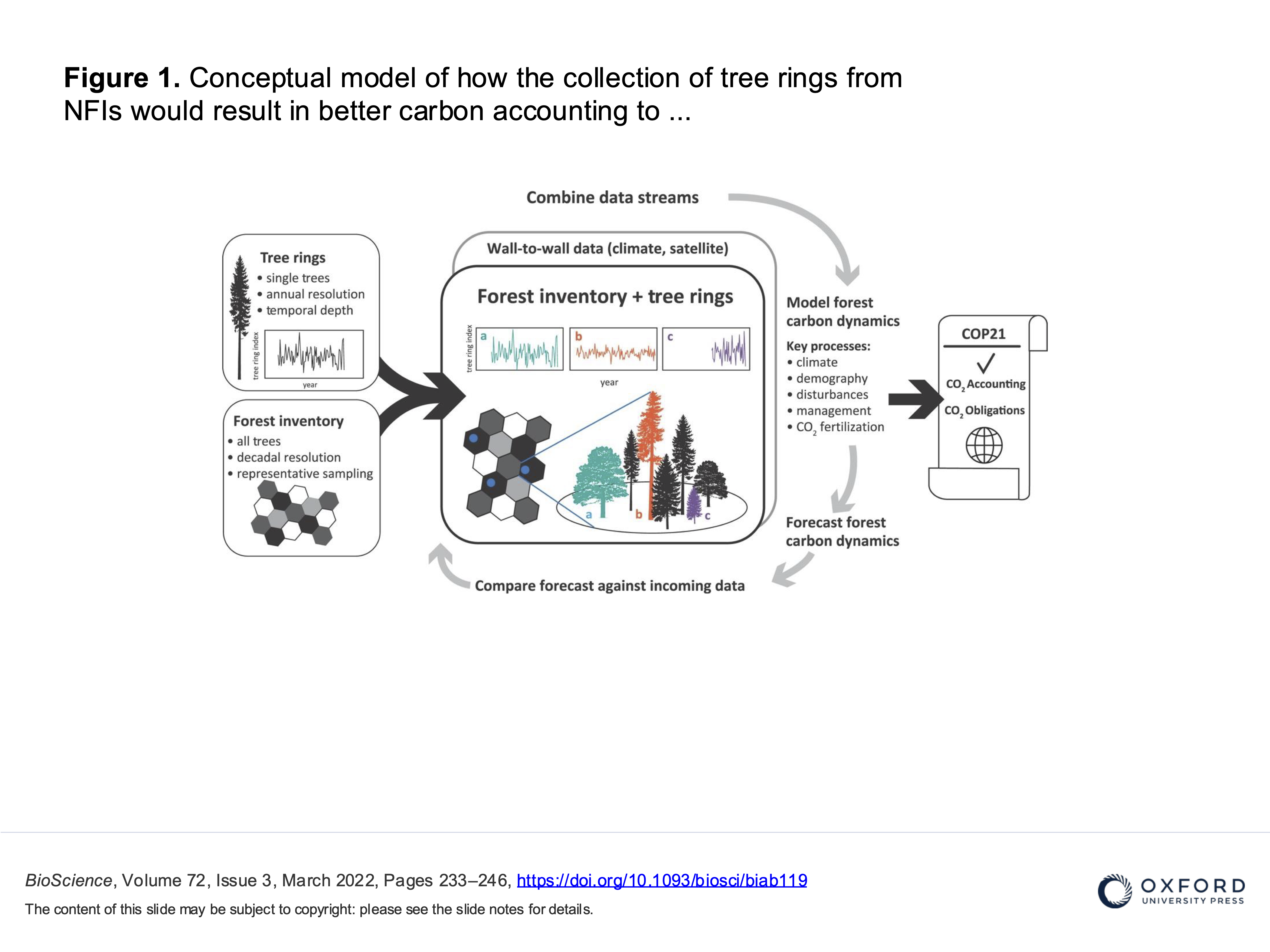
Forest Dynamics and Demography
Estimates of forest carbon and tree-level biomass over time are useful for a variety of applications, including: -understanding drivers of growth and mortality -quantifying the relative roles of growth, mortality, and regeneration in driving forest C over time
Workshop Outline:
We will work through a series of modules
- Introduction & how to work through this tutorial (i.e. this page)
- Introduction of Harvard Forest Census and Tree Ring Data
- Estimating Biomass from Ring width & Census data (no uncertainty)
- Bayesian Growth Model Introduction
- Ring-width only model
- CENSUS only model
- Ring-width + CENSUS data
- Comparing all three estimates
Two options for how to work through this workshop:
- No-code: Work though on this website
- Running .qmd files on Posit Cloud–.qmd files can be run similarly to rmarkdown files
Follow these Instructions for getting started with this tutorial on POSIT cloud.